Concerns over a decrease in HIV financing and donor prioritisation were expressed during a recent meeting organised by the Irish Forum for Global Health (IFGH) and the Dóchas HIV/AIDS Working Group with Irish stakeholders and The Global Fund for HIV/AIDS, TB and Malaria.
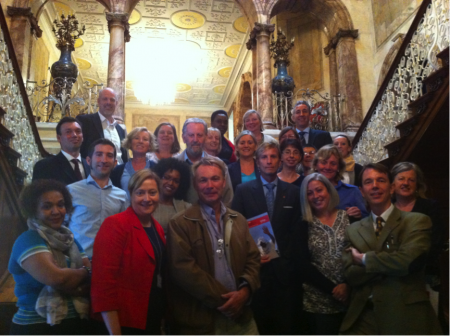
Around 20 representatives from Irish Civil Society met with the Global Fund’s Executive Director Mark Dybul and Graham McNeill from Donor Relations. Participants, including members from Concern, Centre for Global Health, Trócaire and Oxfam, were able to engage in an open discussion on Ireland’s involvement in international development and the future direction of the Global Fund.
Chaired by Nadine Ferris France from IFGH, the meeting was opened by Noreen Gumbo, Chair of the Dóchas HIV/AIDS Working Group, who commended the Global Fund for its commitment to health systems strengthening, policy inclusivity and for placing national stakeholders at the forefront of decision making - but not before providing some background on the new Dóchas policy on HIV/AIDS in response to Ireland’s recently released international development strategy One World, One Future.
Losing focus on HIV
Firstly acknowledging Ireland as a leading international donor, Ms Gumbo raised concerns over a decrease in HIV/AIDS investment stating: “We are so close, yet we see from where we are standing a turning away [from a HIV/AIDS focus]”. The Dóchas report AIDS Is Not Over highlights a concern over the deprioritisation of HIV/AIDS on the development agenda, noting a 48% decrease in Irish Aid spending from 2006 to 2011, while recommending strategies to increase momentum and political leadership.
Following the many optimistic statistics from the Global Fund’s recent Needs Assessment on antiretroviral (ARV) coverage, decreased AIDS and malaria related mortality, and TB detection rates, Dr Dybul reiterated Ms Gumbo’s concerns over donors losing steam in relation to HIV investment by reaffirming that AIDS is not over stating: “We are already seeing an increase of HIV rates in some areas, especially within the most marginalised and vulnerable populations.”
While again acknowledging Ireland’s commitment to international development, tracing it back as a core part of the country’s history, Dr Dybul stated that the donor environment has changed and is often no longer based on purely humanitarian interests but on what he termed ‘enlightened self-interest’: “International donors are working in an integrated world and should recognise the benefits of globalisation increasing economic partnerships, enhancing capacity and opportunities for all parties.”
Changing donor landscape
Not only is the development sector’s thoughts on donating changing, but also how it is practiced and implemented in donor countries. Civil society and country health systems must work in partnership, especially to reach the most vulnerable populations, with domestic financial commitment featuring prominently. Dr Dybul made it clear that the old methods of vertical funding reminiscent of the 1980s are impractical and don’t address key health systems failures. Instead, the Global Fund is working within new more visible models, utilising one funding pool that goes directly to countries, prioritizing local needs, and ultimately to strengthen health systems.
As well as how we provide funding, how we measure its impact needs to improve. Many current output-based evaluations don’t measure real change, highlight populations or groups who are most vulnerable, or consider human rights in their reporting. The Global Fund is focusing more on a results-based framework that shows disaggregated data, by gender and age for example, and also marginalised groups, such as men who have sex with men. When examining results through this lens, as Mark Dybul noted, we are ensuing that gaps in programmes and the most vulnerable individuals are being highlighted.
Bringing health funding and evaluation reporting closer to communities and more in line with country priorities and identified needs is essential to continue success in Global Fund-related programmes, especially in a donor climate that is currently facing resource restriction and a deprioritisation of certain health topics. Recognising health as a human right, and aligning funding policies and reporting within this discourse, needs to remain a priority on the agenda of political leaders because as Dr Dybul stated: “[There is] no disconnect between a results-based framework and human rights”.

Brynne, good piece! There is need to put spot light on reducing international HIV funding. I noticed the trend in 2010 and designed to do a doctoral study because of long term sustainability questions. Well done!
Thanks Henry! And interesting doctoral topic - would love to hear more!