

Programmes to address HIV-related stigma usually focus on changing negative perceptions in the community, but some people living with HIV struggle with self-stigma.
Sarudzai, 42, a woman based in Harare, Zimbabwe who is living with HIV says that for a long time she has been fighting with reality and failing to forgive her late husband.
“Even though my husband died in 2002, I had not forgiven him for infecting me with HIV. I had bitterness towards him and I used to cry when I thought of the day I was diagnosed with HIV,” she said.
Emotional struggle
Due to the negative thoughts and beliefs she had in relation to her HIV status, Sarudzai experienced low self esteem, became stuck in self-pity and lacked all interest in pursuing anything.
“I used to be ashamed of myself and didn’t have confidence in what I was doing. One of my friends asked me why I wasn’t applying for a teaching course and I told her that I couldn’t because I was [HIV] positive,” she said.
Sarudzai’s situation isn’t unique. Grace, 41, another woman living with HIV in Harare, said she used to think that having HIV was a death sentence and that the antiretrovirals (ARVs) were ruining her body.
“When I looked at my bulging tummy, I thought the ARVs were ruining me. I used to think that I would die soon,” she said.
Dealing with negative thoughts
Grace waited for death but it never came. She contracted HIV in 1993 and has now been living with the virus for 21 years. For the past nine, she has been on life-prolonging ARV treatment.
Thanks to Trócaire and the Zimbabwe National Network of People Living with HIV (ZNNP+), Sarudzai, Grace and 21 other participants took part in a 12-week course on dealing with self-stigma and other negative thoughts that people living with HIV have in relation to themselves.
According to the project manager, Nadine Ferris France, the initiative was a little bit different in the sense that previous efforts to address HIV-related stigma have focused on “changing people out there.”
“We don’t have many programmes that are actually focused on us, programmes that are dealing with the negative thoughts that we have about ourselves and that’s self-stigma,” Nadine said.
Living positively
As a result of the project, Sarudzai said she has started to accept reality and love other people who she was blaming for causing the stressful thoughts. “During the course, I wrote a letter making amends with my late husband and I have completely forgiven him,” she said.
Sarudzai has also improved relations with her family, friends and the community. She has even gone to the extent of disclosing her status to fellow church members.
“I used to think that my neighbour didn’t like me because I am [HIV] positive but now I am her friend. I was afraid of disclosing my status to church colleagues because I thought that people would say it’s a curse from God due to promiscuous behaviour. I have since done so and I am encouraging people to go for HIV testing,” Sarudzai said.
Grace has also noted changes in how she views and feels about herself. She has learnt to appreciate herself and to question every negative thought.
“Thoughts like if you are HIV positive then you don’t live longer or it’s a death sentence are not always correct. Right now, I am very healthy and I don’t have any complaints,” she said.
During the course, participants examined various aspects of self-stigma related to HIV such as issues of disclosure, what it means to live with HIV, and sex and sexuality.
Read more stories about HIV and human rights
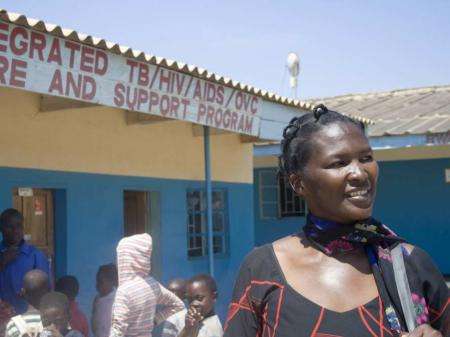
Image: A woman and children stand out side a TB & HIV support clinic in Zambia
© International HIV/AIDS Alliance