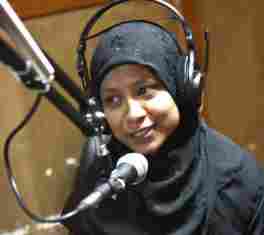
Scovia, aged 22, who lives with her grandparents in the rural area of Kajokeji County in South Sudan, recently tested positive for HIV.
Rural communities, like Kajokeji, lack access to HIV education programmes, health services such as voluntary counselling and testing and antiretroviral treatment. Here, Scovia and her grandfather talk about problems she and her family have faced since her diagnosis:
“I have been experiencing burning sores all over my body, including my private parts, for nearly four weeks,” says Scovia. “When I went to a private clinic in Juba, the doctor diagnosed me as having malarial infections and prescribed for me some drugs for plasmodium [the malaria parasite] and typhoid. But after finishing the drugs, the sores kept increasing. In August 2014, colleagues and friends then advised me to return to my village because treatment in Juba is very expensive.
“The appearance of these sores reminded me of my step mother’s experiences before she died of AIDS in May 2012. I then thought of going for voluntary counselling and testing. I asked my uncle to go with me. The test was HIV positive and then I started the antiretroviral treatment.”
Stigma and discrimination
“I am experiencing stigma because many people in the village still believe that you can only get HIV through sexual acts. But, to be sincere, I have never indulged in sexual practices for income and have not even had a sexual link with a lover, because I need to respect my daughter. My infection possibly came from my second marriage, to a soldier. I became pregnant during my adolescent years, but my first boyfriend disappeared when I told him I was pregnant.
“The risk of infection comes as young people leave the villages and travel to the cities in search of jobs. Some other people I know stay idle for the whole day, disappear at sunset and return home late in the night – making a living as sex workers. Others work in the simple business of being waiters in bars, lodges and hotels, while I have been making tea and selling fried peanuts along the roads. I cannot speak English, which would enable me to look for a better job.
“My biggest worry is my mother. On disclosing my HIV positive status, she collapsed with tears. She believes that a person who is HIV positive is living to die. The worst of it is that I am her only daughter. So instead of me, my mother needed the counselling and guidance.”
Grandfather speaks out
Scovia’s grandfather, a former priest, is also struggling to come to terms with her diagnosis. “Could it be a curse or test of my Christian faith?” he asks. “I lost my elder daughter to AIDS in May 2012, leaving four children as orphans. She was having similar body sores to those appearing on Scovia’s body.
“Out of the four children, the youngest child, Joseph (aged 12) also had some marks on his skin that looked like ringworm. His elder sister took him for voluntary counselling and testing three times. The second test revealed that the child is living with the virus.
“The biggest issue worrying me is the distance to the main hospital. It takes three to four hours walking to get to the hospital but now, as old as I am, how will I help to get access for the drugs for these two grandchildren of mine? Secondly, the food eaten in the villages is not nutritious enough to provide what their bodies’ need.
“As a family, we must respect their health status by avoiding stigmatizing and discriminating words.”
Read about HIV and human rights
As a key correspondent, i would like to thank Lisok Elozai Scopas. for such a good story, South Sudan has gone through many wars but presenting such a story really it is encouraging. This is good to hear from you KC from Sudan Thanks
thanks a lot for your comment.