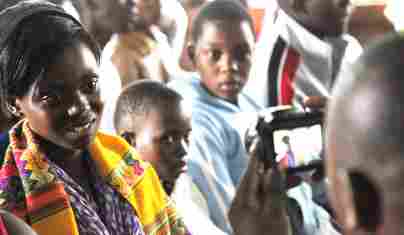
As she settles in her chair, Nomsa quickly scans the unfamiliar faces in the group and asks who her interpreter will be.
“I do not want to talk to journalists who are from South Africa,” says the 60-year-old South African nurse, as she starts her conversation with half a dozen African journalists crowded in a small room at the Themba Lethu clinic in Johannesburg, a large government clinic providing anti-retroviral treatment (ART).
Nomsa is not at Themba Lethu in her role as a nurse, she is here today to get her dosage of life prolonging ART - in fact this is the clinic where she was counselled and tested ten years ago.
“I was infected by a boyfriend who was younger than me,” Nomsa recalls. But she fears that if her story is published in local South African newspapers, it may be read by friends and family members.
“I do not want to be stigmatised,” she says.
Women more vulnerable
Health scholars define stigma as a complex social phenomenon or process that results in a powerful and discrediting social label and/or radical changes in the way individuals view themselves and are viewed by others.
Stigma and discrimination associated with HIV and AIDS are universal, occurring in every country and region of the world. People living with HIV are often abused, rejected and overlooked.
While women are usually more willing to go for voluntary counselling and testing for HIV, they are also on the receiving end when it comes to stigma and discrimination.
Sue Roberts, project manager at the Themba Lethu clinic at Helen Joseph Hospital, says: “Men mostly avoid testing while women will want to do so because they have to be strong to look after children and the rest of the family.”
However Roberts says she has received reports in South Africa of husbands chasing their spouses with panga knives, locking them in houses and feeding them through windows like dogs simply because the wives have tested HIV positive.
Health workers and stigma
The problem of stigma is also common among health workers in South Africa and across the globe.
“It’s not easy for us to tell one another when we are found to be HIV positive. There is too much stigma and speculation among us nurses,” Nomsa says.
Nomsa’s worries were corroborated by Roberts: “Our staff members find it very difficult to be open about HIV even though we have a staff death every month, there is a lot of stigma among health workers.”
She says the situation is exacerbating already difficult conditions in the health sector which is losing a number of nurses due to a ‘brain drain’ with many qualified medical staff seeking work abroad and others leaving the profession altogether.
Ironically, Nomsa provides counselling at the clinic to people who are living with HIV but she has not disclosed to her four children that she is living with the virus.
Reducing stigma among healthcare workers in Malawi
Malawi is another southern Africa country not spared the fear of stigma and discrimination among healthcare workers. As such, the Network of Health Care Workers Living Positively (HECAWLP) – which comes under the National Organization of Nurses and Midwives – is working towards reducing the levels of stigma and discrimination in the health sector.
Macmillan Lingomanje, the only senior male health worker living openly with HIV in Malawi, says that HECAWLP support groups are in almost every health centre and, through financial support from the National AIDS Commission and Norwegian nurses, are undertaking a number of activities.
“We conduct home visits to uplift nurses in post-trauma cases. HECAWLP is planning to link up such cases with pastors who have been trained in palliative care,” he said.
Lingomanje, who specialized in intensive care and obstetric anaesthesia at Zomba General Hospital in Malawi’s old capital, says that through solidarity funds HECAWLP is sponsoring some orphans whose parents were health workers and passed away from AIDS-related disease.
“Some needy nurses are being supported by well wishers within HECAWLP to start income-generating activities to support themselves and their families. We are also lobbying for wellness centres for all health facilities in Malawi for HECAWLP members,” said Lingomanje.
Read more stories about HIV and human rights