

In South Africa, young men who have sex with men are increasingly exploring their sexuality at university, without always understanding the HIV and other health risks they are taking.
Yet there are few programmes and awareness campaigns address that focus on young men who have sex with men to address these issues.
Globally young people are at a higher risk of contracting HIV; more than half of those newly infected with HIV today are aged between 15 and 24 (UNAIDS). And young men who have sex with men are at an even higher risk of transmission, as the risk of contracting HIV from unprotected anal sex is especially high.
Risky sexual behaviour at university
Students, in general, are also at an even higher risk of HIV transmission considering they are at a phase of forming interpersonal relationships and taking part in sexual experimentations. In South Africa, a study across 14 higher education institutions involving sexual minorities, found risky sexual behaviour is increasing the risk of HIV transmission among these population groups (Higher Education and Training HIV/AIDS Programme in partnership with the Networking HIV/AIDS).
The study found that young gay and bisexual students are coming out of the closet, particularly in tertiary education institutions where they are more likely to meet their counterparts. But it is important to understand that not all men who have sex with men identify as gay. The study found that some men who identify as heterosexual engage in unprotected sex with other men, as well as having unprotected sex with female partners.
Based on its findings the study calls for more programmes at education institutions, and greater involvement of male students who have sex with men in such programmes, to help reduce the risk of HIV transmission.
Tackling stigma and discrimination
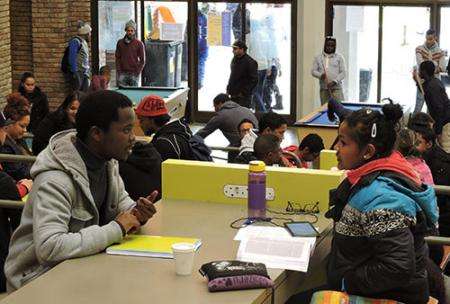
At the University of Western Cape a programme for men who have sex with men, as well as people who are lesbian, gay, bisexual, transgender or intersex (LGBTI) is improving the lives of many students.
Qamani Vonya, a 23-year-old law student, says he was attracted to men from the age of 11. Growing up as a gay teenage boy in a community which discriminated against homosexuals wasn’t easy for Qamani. “Many times I have been told by my maternal aunt to ‘stop being gay’ and not befriend the people I call my friends and there are times when I was still young where my father would be angry if I do feminine duties in the house rather than being tough and playing soccer with other boys in my neighbourhood,” says Qamani.
Qamani lost a number of friends over the years because of his sexuality but says he found it easier to be himself at university. Even though he describes campus as being a lot safer, he says he still experiences stigma and discrimination. “University has been such a challenge because many people say they do not understand homosexuality and I have also had encounters with my friends who would have opinions about my sexuality which are mainly stereotypes. Many of the female friends I have are accepting but usually it is their male friends that are not comfortable, and I feel some hostility in their presence,” stated Qamani.
Qamani adds that he had limited health information and took part in sexual activities not knowing the health dangers that came with it, but the programme is helping to change things, particularly through discussion groups for people who are LGBTI. It also helps students to become involved in events such as Cape Town Gay Pride, by hosting Pride events on campus that advocate for a free and equal society and are open for anyone to join.
“It has enlightened me tremendously as I feel like I am more aware of my sexuality and other issues,” says Qamani.
Hope for sexual minorities
The University of Western Cape (UWC) also offers support for women and LGBTI people through its Gender Equity Unit, which was set up after it was found that the institution was lacking in their policy response to gender disparities and inequality on campus.
The unit furthers the struggle for the empowerment of women and continually raises the agenda for women’s rights on all levels. It has also become a safe space for students and staff who are marginalised because of gender identity, sexuality, sexual orientation, sexual expression and behaviour; including students and staff who do not conform to heteronormative gender or sexual stereotypes or roles.
Many students who identify as LGBTI access this space and its services, including mentoring and crisis intervention. The unit also hosts the two LGBTI student societies (Loud Enough and Gayla).
Naythan Kayser, project coordinator at UWC, says: “The HIV and AIDS programme’s MSM/LGBTI project in collaboration with the Gender Equity Unit is collectively trying to create a safe and enabling environment for LGBTI students at UWC. We have done this by implementing sensitisation workshops for support staff, creating safe spaces on campus and constantly generating open dialogue for LGBTI voices to be heard. We take pride in having annual events that focus only on LGBTI awareness on campus, by doing this we are reassuring LGBTI students that they truly do matter and that we strive towards inclusivity at our university.”
To reduce the risk of HIV transmission among sexual minorities in university, more programmes such as the one at the UWC need to be put in place. Without such programmes, people like Qamani would still be in the dark and still taking part in risky sexual behaviour.
Read about adolescent girls being the new face of HIV