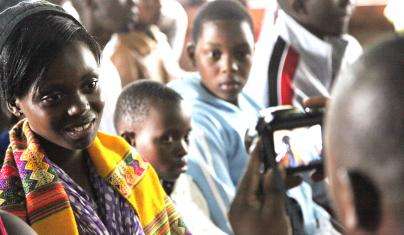


A stage full of young people buzzes with energy. A woman stands with a guitar, strums and sings into a microphone with limitless passion. Others around her join in, dancing and singing the words: “It’s not my fault that this blood flows through me. In this storm we’ve learned to dance.”
This is an uplifting music video called How to dance, produced by young people living with HIV and the NGO Africaid-Zvandiri. It was a perfect start to a session at the International Conference on AIDS and STIs in Africa (29 November – 4 December) about engaging young people in HIV treatment and care.
Adolescents then spoke through a short film about the solutions they want as part of their services. Africaid-Zvandiri, together with Zimbabwe’s Ministry of Health and Child Care, the International HIV/AIDS Alliance, Y+, WHO, UNICEF and the Global Fund, then hosted a panel discussion on engaging adolescents in HIV treatment and care, including improving approaches for service delivery.
The objectives of the session were to share examples of service delivery models for adolescent HIV treatment and care. It particularly provided strategies for ensuring meaningful youth participation in service provision.
The challenge
Cedric Nininahazwe, a young activist from Burundi, talked about the challenges adolescents face when they have to deal with being HIV positive and being from a marginalised population, such as men who have sex with men or sex workers.
Nininahazwe said: “At times they have to deal with the attitude of the health service providers, and sometimes they are not given adequate health services. One gay man had a sexually transmitted infection and when he went to the health facility the doctor told him to seek a prophet/pastor and not medical help.”
Dr Mo Archary spoke about challenges relating to service provision in antiretroviral (ARV) clinics in KwaZulu-Natal, South Africa: “Our ARV clinics usually have long queues of mixed age groups and are understaffed.” This makes it difficult to meet the specific needs of young people.
What can be done?
At community level, Loyce Maturu from Africaid-Zvandiri in Zimbabwe, spoke about the power of peer-led community-based approaches, focusing particularly on the Zvandiri model. “Peer led interventions reach the intended target – adolescents – and they help the adolescents open up more.”
At government level, the Ministry of Health and Child Care in Zimbabwe was represented by Dr Joseph Murungu, who talked about the importance of scaling up HIV care services for adolescents.
From a global financing perspective, countries can approach strategic investments for adolescents through their Global Fund proposals and Dr Ade Fakoya, senior disease coordinator for HIV at the Global Fund, encouraged stakeholders at country-level to be vocal and speak up, saying: “Show me the money, more love less stigma.”
Anurita Bains, regional advisor for HIV in the UNICEF Regional Office for Eastern and Southern Africa, upheld this year’s conference as unique: “This year’s ICASA is different from the previous editions of the conference in that it is really focusing on adolescent as a separate group rather than young people as a whole.”
With many stakeholders from different backgrounds wanting to know how best to cater for adolescents and build a better world where young people thrive, live positively and are empowered, there is real hope and excitement for change and innovation for adolescents across the region.
Read: couples HIV testing during antenatal care - a good idea?
Well done guys for impact!