

Fish mongers have been engaging in a community dialogue about maternal health and HIV.
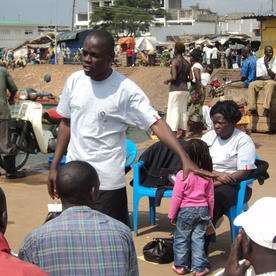
The meeting, which included men and woman from the local community, took place at the Gaba landing site in Makindye, Kampala last month (9 September 2011). It was facilitated by the Community Health and Information Network (CHAIN) and included local leaders plus CHAIN’s maternal, newborn and child health awareness group.
Pius Otto, the officer in charge of the police post at Gaba landing site, said the area has a high population that “keeps on mushrooming every day”. He said the area is dominated by excessive drinking, drug addiction and domestic violence and it is common for women to be battered, regardless of whether they are pregnant or not. He added that these are the cases he mostly deals with at the police post.
Pius said the community mostly goes to nearby health clinics, which are expensive. He said Kansanga Health Center Four offers free health services but is too far a distance from the area. He made a plea to the government to build a health center at the landing site.
Further information was presented that community members go to Killuddu Health Center, a government facility that is closer to the site. Sonko Charles, a participant, described the facility as good but said that, as it opens at 7am and closes at 11am, it is only open for a short period of time. He went on to say that getting transport to center would be very hard during night time.
Harbert Kimbugwe, a health researcher on the CHAIN team, said the reason for the dialogue was to pave ways to stop the deaths of the 16 mothers who die every day due to pregnancy and child related complications in Uganda. He added that the father, mother, government and the doctor are responsible for these deaths.
However, one participant had a different perspective on the groups responsible for the current crisis in maternal health. He said health clinics give wrong medication for HIV and AIDS and that traditional healers often give different names for HIV and AIDS to fool their clients into using local herbs.
A father said women at the landing site like receiving health services from traditional healers, which leads to infection, due to the poor methods they use to treat sexually transmitted infections (STIs), particularly HIV.
Harbert told the men that women complain about men’s lack of responsibility during pregnancy. He said men often don’t want to buy mama kits.
When the men present were asked what a mama kit was, they didn’t know. A mother said a mama kit costs 30,000 Uganda shillings in hospital but it’s not necessary to buy them there as people can collect the kit’s components outside the hospital at a cheaper price. The men were advised to buy the mama kits piece by piece to help them spend less.
Men were asked how they know when their wives are pregnant. One participant said: “musibira kusati emyezii ebilli” (“I tie her on my shirt for two month” ), explaining he didn’t let his wife out of the house for two months so they could have enough sex to make sure she gets pregnant. Another said the way to tell is when a woman “asks for a lot of money”. Herbert told the men that in most cases it’s the woman who tells the man she is pregnant.
Most of the men said a woman should go for antenatal after three months. Others suggested at one month because a woman might have syphilis. Another said since ladies take a long time in family planning so they should go right away.
One man questioned the number of family planning methods that exist. He said some women become very big [confident], others bleed, and the rest loose their sexual feelings. Herbert said family planning should be agreed on by both partners. He went on to say a woman becomes big because when fully complying with family planning rules she gains a lot of freedom. He said women bleed because they don’t want to go for a check up, yet the doctor tells you which family planning method you are supposed to use, so such complications result because of a lack of consent from the doctor on which method you are to use.
Women were warned not to have a poor approach to family spacing. Here, Harbert said women child space without telling their husbands, which leads some men to go out and cheat on their wives in order to have more children. He said it should not be thought of as family spacing but family planning.
Men said they don’t go for antenatal because they are very busy, because of women’s “rude pregnancy attitude” and because they are mistreated by health workers. They were advised that hospital policies have been changed recently; If a woman goes with a man for antenatal, they get attention right away from doctors.
Harbert said: “Men pretend to be busy yet they just go play gambling games. Men only become busy when the wives are pregnant.” In response, a meeting participant said women trick men by getting unexpected pregnancies and that’s why men are also reluctant to go for antenatal care. Harbert said to stop the issue of unexpected pregnancies men need to use condoms. He added that this also applies when a mother has just given birth.
On the issue of poor doctors’ attitudes, Masitula Nakisozi, a facilitator on the CHAIN team, said they have made a plea to the government to motivate health workers and to retire ‘old age’ doctors. “Bagubba dda”, one participant said. (“Doctors can’t easily adopt a new good behaviour.”). Participant Sonko Charles said when he took his wife to Mulago referral hospital to give birth in 2008, he saw a unfortunate incident in the labour ward where a pregnant woman was sent off a mattress to lie with other patients on the floor so that the doctor’s cat could sleep on the matress.
Munyanja Sunday said when he took his wife Nakissasa Agnes to Mulago hospital to give birth in 2007, it happened that she had no money on her and he did not know because he was left outside, so she gave birth with help of women who were inside the labour ward and not the midwife. He went on to say: “If you have 100,000, you can easily access good services at Mulago referral hospital unlike when you nothing.”
Muyanja spoke about another case of his sister who gave birth by an operation. She was taken to Mulago hospital in labour pains at 2pm; however, by midnight she wasn’t yet put on the list of those due to go in the labour ward. He said it was only when they rang a friend called Dr. Kagoda, who connected them to a lady, that they were put on the list right away and in a few minutes his sister gave birth. At one point of the long wait, Muyanja said he almost opted to take his sister somewhere else but couldn’t because he did not have money.
Members of the meeting were told they have a mandate to tell the doctors what they needed while at hospital. However, the members made a plea to civil society organisations to send women to the area who are taught, through maternal health and HIV/AIDS dialogues, to monitor women who give birth in hospital.
When asked about child ownership, men said a child belonged to the man because of chromosomes, while others said men are the owners through their blood group. However, Harbert said a child belongs to both a woman and a man. He added that, even if asking for custody of a child from the government, the government may give it to the one who has the ability to care for the child but the child still belongs to both and should still be given full attention from both parents.
Harbert told the woman present that, when they go for antenatal, it helps to know their status so that their baby can be born HIV free. Masitula asked the participants why they did not want to test, answers included: “nelalikirila, sirya mere” (“I worry to the extent of not eating food”); another said he is scared because “he knows he has not been on the right path”.
Masitula went on to that, even when you are HIV positive, you still remain with every right, but what kills most people is self stigma. She advised that you can still have a baby even when infected with HIV; all you need to do is to go for a check up so that the doctor can see your immunity and if he accepts you, you can have a baby. She also advised women to go for antenatal care as soon as they realise they are pregnant in order to get services that prevent the transmission of HIV from mother to child.
Herbert also advised that the 40 days before and after giving birth are risky. He cautioned men to wait for at least this long before having sex with their partner, and to help out with some duties during this time. He also appealed to men to “stop mistreating” their women during pregnancy because a baby can get infected with HIV this way.
Masitula said breast feeding can also lead to a baby becoming infected with HIV. However, on that she said HIV positive women should breast feed their babies for the first three month without giving them any other diet.
One participant asked whether it was true that when an HIV positive mother is about to give birth, she is given a tablet to prevent mother to child transmission, which works for the rest of the baby’s life. She was told that this was false – that HIV positive mothers are given Niverapin to stop the transmission of HIV but that this works only at that moment.
Masitula, who is HIV positive, told participants she wasn’t on antiretrovirals (ARVs)S but Septrine and has survived. She said that this is because an infected person’s medication is determined by their immune system, which is tested through the CD4 count, and all of this is told to you by the doctor.
Herbert said, if used correctly, a condom is 100 percent effective for protecting against HIV, but that people say it is 99 percent effective because people don’t how to use it. He demonstrated how to use a condom and also gave them out to the participants.
When discussing ways forward, the participants asked for radio shows and television programs regarding maternal health, HIV and AIDS, They also asked CHAIN to talk to traditional healers on the matte Since the area is very big the group requested more dialogues. The participants promised to apply what they had learnt and spreading out the information further.