


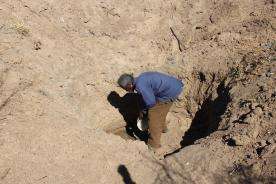
In 1963 ZANU PF was formed, and the very same year somewhere in Tsholotsho, Siyaphambili village, Phillip Mpala settled with his family. This man had never had access to clean and safe water.
When this very same party came into power in 1980 his hopes went high for a better future. But a few years later what he got was the Gukurahundi massacre. Mpala lost his entire family, close friends and relatives. All were wiped out and buried in shallow, sand graves.
Gukurahundi was a short lived, ethnic civil war that the President of Zimbabwe Robert Mugabe (a member of the Shona tribe) unleashed against the Ndebele tribe in the early 80s. Innocent civilians, mainly women and children, were killed for no apparent reason. Years later, President Mugabe described the massacre as a “moment of madness.”
The reason for Gukurahundi was purely political as there was a belief that the Ndebele tribe, under the leadership of the late Joshua Nkomo, was mobilising to topple the incumbent Mugabe.
From that time onwards the Ndebeles has accused the government of marginalisation. No meaningful development has ever taken place in the Matabeleland provinces compared to other provinces.
Mpala is now a village head, whose ward area has about 85 households. He said: “We have had a change of members of parliament from 1980, and one or two have drilled boreholes, which have since broken down. The situation has deteriorated for the last ten years because the availability of water from the Gwai River has been erratic.
“We have tried to engage our member of parliament [Jonathan Moyo] but the last time we saw him was during election time campaigning.”
Women, who bear the burden of household chores, now travel long distances to fetch water from the available open water sources. Villagers get dirty water, which in most cases has been contaminated by animals. It is by God’s grace that diseases such as cholera or typhoid are not prevalent in the area but if one day they are imported from another village the outbreak would be disastrous.
Jonathan Moyo, the local MP, is well known by the urban elite, who have access to radio, television and newspaper, for writing long newspaper articles denouncing the Movement for Democratic Change and its leader Morgan Tsvangirai, but he cannot even use the Constitutional Development Fund (CDF) to drill or repair one borehole.
The water and sanitation situation is even worse in districts furthest from the Siyaphambili village where people take flight with animals to quench their thirst. In the very same area the majority of children do not go to school because they cannot afford to pay school fees, yet their MP spends most of his time penning articles to divide the once peaceful, loving Zimbabweans.
But there is hope for the district, brought about by the United Kingdom’s Department for International Development (DFID) and the Minister of Water under the new Rural Water, Sanitation and Hygiene programme (WASH).
WASH is a US$50 million programme, which will be managed by UNICEF, to improve water and sanitation facilities in rural areas of Zimbabwe.
The programme was launched this month (July 2012) by Prime Minister Tsvangirai. Bemoaning the delay in bringing adequate water and sanitation to the area, he said: “The Zambezi Matabeleland water project is a huge project in terms of its structure and scope. For a long time we have not been able to implement it. That project has been on the book for hundred years and that explains the capacity that is required for government to undertake.”
Dr Peter Salam, UNICEF representative to Zimbabwe, said 30% of rural households do not have access to safe water compared to less than 5% of urban households. Around 70% of rural households do not have improved toilet facilities. Of these, 30% practice open defecation.
The rural WASH programme will be implemented in 30 districts in five Zimbabwean provinces over five years. Close to 2.5 million people will have year round access to safe water supplies and sanitation facilities.
Salam said diarrhoeal diseases, which result mainly from poor water and sanitation facilities, account for the unnecessary loss of life, especially among children under five.
Zimbabwe’s water supply and sanitation services have suffered a major collapse in both rural and urban areas due to years of under-investment. Although some progress has been made in rehabilitating water infrastructure in urban areas, rural populations continue to bear the brunt of poor water and sanitation in the country.

When I read these stories I moan. Leadership is key. Thanks.
such issues need to be addressed by our leaders, its like we vote for nothing. Thanks Robert