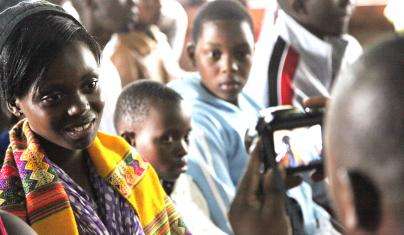


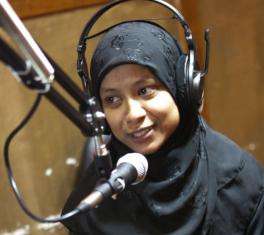
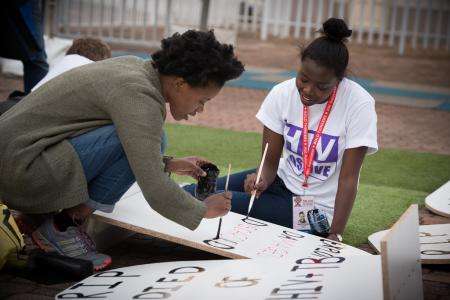
Young people must have the right support to empower them to make meaningful contributions to HIV programming and decision-making, according to delegates at the AIDS 2016 conference in Durban.
With an estimated 2,100 young people becoming infected by HIV every day, ambitious targets such as the UNAIDS 90-90-90 campaign cannot be achieved without their active participation.
During an interactive session at the conference, Linda Mafu who is the head of civil society and political advocacy at the Global Fund, argued that it is important for young people to be involved in addressing HIV/AIDS issues, but noted that they lack mentoring and support.
“Let’s give the resources to young people,” she said. “Apart from redoubling the effort, let’s redouble the money as well. We need resources and networks to be made available to young people. As a young person, I was given space by the elder men and women to think of initiatives and that’s why I am here today. We also need mentoring programmes in place for the youth leaders.”
Young people can deliver
Jacquelyne Alesi, who heads the Uganda Network of Young People Living with HIV/AIDS, said that although young people’s abilities are mostly underestimated, they can do well with enough support.
Through her role, Alesi is involved with Link Up. This initiative by the International HIV/AIDS Alliance is improving the sexual and reproductive health and rights of more than one million young people in Bangladesh, Burundi, Ethiopia, Myanmar and Uganda.
Alesi said Link Up has helped her connect with other young people internationally, especially those living with HIV.
“We need to draw a line between young people being used and being engaged, so our organisation came up with a governance strategy,” she said. “It’s high time we started recognising the energy of young people. I am a living example that they can deliver if given support and opportunity.”
Twenty-two-year-old Myo Thet Oo from Myanmar has achieved more than many of his age. An engineer by education, Myo Thet Oo became passionate about HIV advocacy partly because some of his own family members are living with HIV.
Now a project manager for Myanmar Youth Stars, he says that as a young person he understands the needs of young people better and can easily communicate with them without using expert language. “Link up has completely changed our focus in addressing HIV/AIDS and sexual reproductive health services,” he added.
A seat at the table
Raoul Fransen, a delegate from Global Fund, says that one of the challenges in youth engagement and activism is “how we develop our programmes because if young people are to be represented they need connections and support.”
He adds: “A lot of young people are building their careers because of activism, which is amazing, but you also need to look beyond the youthful stage. There is need not only to provide a seat at the table but also make the engagement meaningful as well.
“Young people are being represented in conferences more than ever before. In 2000, you could only find two young people at a conference. Moving on to 2004, there used to be something like 200 – but at this conference we’re talking in the thousands. There is, however, lip service among policymakers. We need to have support structures rather than just being invited to conferences.”