The broadness of Agenda 2030 may shift the focus on HIV.
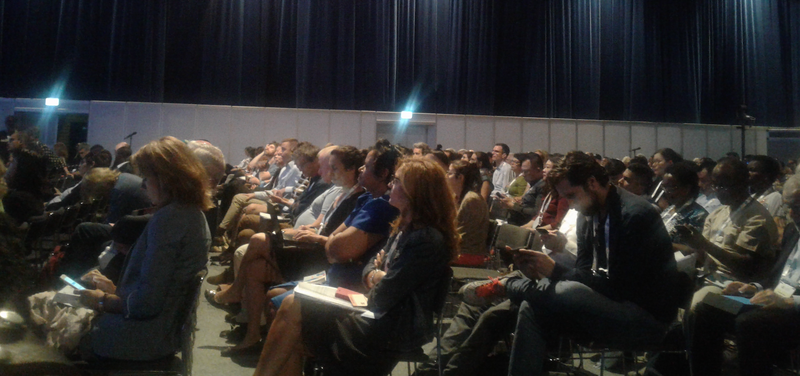
On the 24th of July, 2018 at the Aids International Society Conference in Amsterdam, the Netherlands, a heated debate broke out amongst two groups on whether Agenda 2030 is a threat or an opportunity for the HIV response.
Agenda 2030, otherwise known as “Transforming our World: the 2030 Agenda for Sustainable Development” includes 17 Sustainable Development Goals (SDGs) and 169 targets. These were adopted on the 25th September, 2015 by Heads of State and Government at a special United Nation (UN) summit. The agenda is a commitment to eradicate poverty and achieve sustainable development by 2030 worldwide – ensuring that no-one is left behind. The adoption of this agenda was a landmark achievement providing a shared global vision towards sustainable development for all.
J.V.R Prasanda Rao, a United Nations employee, was the first speaker to support the motion. He spoke of their experiences in India on using Agenda 2030 to strengthen the HIV response. He indicated that for a long time HIV has been treated as a stand-alone subject while in the fight against HIV, countries need to also consider social determinants such as nutrition, poverty, equality and many others. 
In his opinion, Agenda 2030 sets targets and has an element of accountability for governments because it a high-stake political commitment. Michael H. Merson of Duke University, United States echoed the sentiments shared by Rao. He submitted that the agenda speaks to universal health care. Adding that HIV needs a multi-sectional approach to eradicate Aids by 2030. He said that the word “Integration” encapsulates Agenda 2030 and has been lacking for the past 30 years in the fight against HIV.
The motion was opposed by Volody Kurpita, Centre for Health, Ministry of Health, Ukraine and his colleague Christine Stegling. His argument was that the agenda is ambiguous and cannot be realised. Three years have passed since its adoption and nothing has been done on the ground, he said. He mentioned that 169 targets is a huge number and countries will not be able to fulfil them.
Kurpita emphasised that the expectations of the key populations (KPs) who are most vulnerable to HIV infection are not reflected in the document. “The document is too complex for most UN states to understand and there are no linkages between the targets, which makes it even more difficult to talk of integration.”
Stegling, who argued against Agenda 2030, said that the Aids agenda is going to be swallowed up. Agenda 2030 is too broad and governments are not going to report well on the progress on HIV. She indicated that community-led organisations will be left behind as the agenda gets bigger and bigger, yet there is evidence that 50% of people living with HIV are KPs across the globe. The focus on them will be lost in the process.
As the panel opened to the floor some civil society organisations, particularly from Africa, voiced their concerns. They agreed that the agenda serves no purpose for African countries who are firm on the criminalisation of KPs.
A question was posed to the panellists: How effective is this political commitment when most countries continue to threaten the rights of KPs? They argued that Agenda 2030 is just a white elephant which has nothing to do with the fight against HIV.
Conversely, most people from the floor supported the motion. They strongly believed that Agenda 2030 is a weapon that can be used by civil society organisations to hold governments accountable at both national and international levels. They said that many of the goals and targets of the SDGs are interlinked and call for integrated solutions. Decades of the experience in the global HIV/Aids fight have shown how communities affected by HIV have a whole range of needs that cannot be addressed by providing HIV services alone.
After serious deliberation the audience was allowed time to vote. The votes were split in half, indicating that in as much as Agenda 2030 is believed to be a comprehensive response to the global challenge on the pandemic, some people fear that the it will leave others behind, especially KPs.
In her concluding remarks as the chair of the panel, Mandeep Dhaliwal of the United Nations Development Programme (UNDP) United States, stated that Agenda 2030 is intended to address the diverse and complex challenges in the fight against HIV. These challenges demanded a coordination of government, civil society and the private sector. “The basis for the fear against Agenda 2030 cannot be underestimated and [must be] addressed.” The movement against Aids led by people living with and affected by HIV which inspires the world even today, should form part of the coordination efforts.

COMMENTS