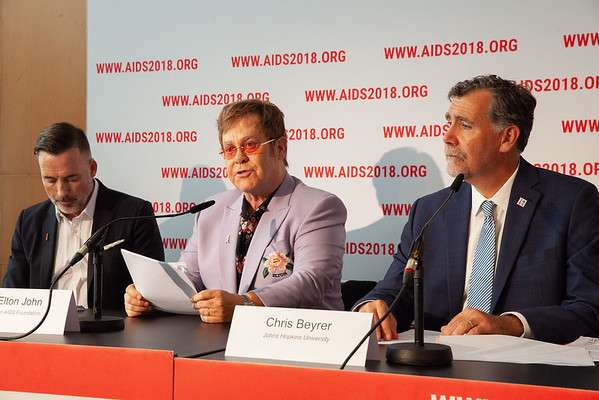
The responses to AIDS have been framed by many urgencies, but the need for funding remains inescapable. New data was released at the Aids International Society Conference (AIDS 2018) hosted in Amsterdam which ran from the 23rd – 28th of July. It revealed a significant, $6 Billion gap between what is available for the response and what is needed to realise effective global access to prevention, treatment and care.
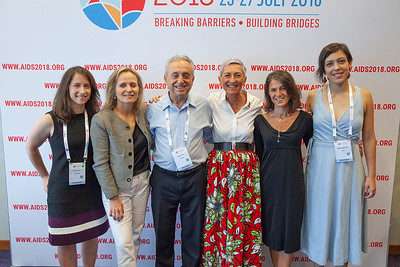
The Netherlands, Amsterdam, 24-7-2018. Press Conference HIV Prevention Highlights Research. L-R Rebecca Zash, Sharon Lewin, Pedro Cahn, Linda-Gail Bekker, Sarah Fidler, Mariana Veloso Meireles. Photo: Rob Huibers for IAS. (Please publish always with complete attribution).
It’s alarming to note that more than half of major donor governments decreased their HIV commitments in 2017. And no new significant commitments from international donors have come to the fore. Another surprising fact is that treatment scale-up has flattened out amidst annual HIV fatalities reaching 1 million. This positions us very far from reaching the UNAIDS 2020 treatment goals. And if the funding gap is not promptly decreased, the shortfall could lead to millions of unnecessary HIV infections and deaths.
With the grim possibility of regressing in our achievements towards eradicating HIV, this year’s conference illuminated the often-overlooked need for a holistic approach. The conversation centred specifically on the need to address the comprehensive health and wellbeing needs of people affected by HIV – from the Generation Now pre-conference on HIV, and sexual and reproductive health, to calls to integrate care and treatment of HIV and TB – the main killer of people with HIV. Throughout the conference, reports on programmes that integrate HIV diagnosis and treatment with care for hepatitis, STIs, hypertension, diabetes and other health concerns showed that these initiatives deliver better, more effective and more cost-effective care than programmes that study single health issues in isolation.
World Health Organisation (WHO) Director-General Tedros Ghebreyesus, who spoke at the conference’s opening session, reminded everyone that responding to HIV is not a one-dimensional approach. That it cannot be.
“We have not truly helped a child if we treat her for HIV, but do not vaccinate her against measles. We have not truly helped a gay man if we give him PrEP but leave his depression untreated. We have not truly helped a sex worker if we give her STI screening but not cancer screening.
Universal health coverage means ensuring all people have access to all the services they need, for all diseases and conditions,” he said.
If we are to truly get through to the heart of the epidemic we must remember that the fight is about more than HIV. Social justice and the resources to implement it can never be divorced from the fight against HIV. In the same way that funding plays an important role in mobilising the resources for treatment and research, creating environments that recognise the multiple components of healthcare and treatment for all conditions becomes imperative.
22nd International AIDS Conference (AIDS 2018) Amsterdam, Netherlands Copyright: Marcus Rose/IAS Photo shows: TB 2018: Bridging the TB and HIV Communities. Discussion: Bringing TB prevention to scale. Poster Exhibition.
Recognising that fighting HIV is about more than HIV means highlighting the gauntlet that minorities brave while living with the virus. Gender, class, race, ability and sexuality all impact along different intersections within one body. Opportunistic infections remain a risk factor, in the same way that poorly attended mental health does. Targeted solutions that allocate resources proportionately to populations, while taking their unique challenges and barriers into account are necessary.
The tools are in hand and the direction is clear for those who took the stage at AIDS 2018. Solutions can only be found once a problem is named. In this case the problem remains more than the sum of its parts. But with innovation and foresight hope for an advanced conversation looks on towards AIDS 2019.

COMMENTS