Peer promoters and educators are on the frontlines in Key Population health interventions
Zambia is among several Southern African Development Community (SADC) countries benefiting from health interventions targeting Key Populations (KPs). These interventions use data and evidence mostly generated from international best practice. The Global Fund and International non-governmental organisations (INGOs) have stepped in to undertake localised and epidemiologically targeted areas in Zambia. On the frontlines are teams of peer promoters and educators engaged in endorsing social and behavioural change. They refer KPs to service providers in and around their localities.
Inter-organisational referral systems for health service provision have been ongoing. This includes small-scale initiatives and a localised arrangement between community-based organisations (CBOs) serving the LGBTQI+ communities. This has been concentrated in the capital city of Lusaka.
Local CBOs have gone the extra mile to identify LGBT+ friendly healthcare providers (HCP) and health centres in Lusaka. “We have been doing this for some time even before the INGOs stepped in,” emphasised Christopher Mwenda* who represents a local CBO. “What we are seeing is a scaling-up of the health and HIV services provision. It is not a bad idea at all to be
the major players.”As of January this year Zambia had about five CBOs working with KPs and partnering with INGOs. The Global Fund is working with the Ministry of Health through the National HIV/AIDS/STIs/TB Council (NAC) on issues of Key Population Health Programming. The list is bound to increase steadily as international players find Zambia a beneficial country to establish KP-friendly health services in, despite the restrictive legal and hostile socio-political landscape. 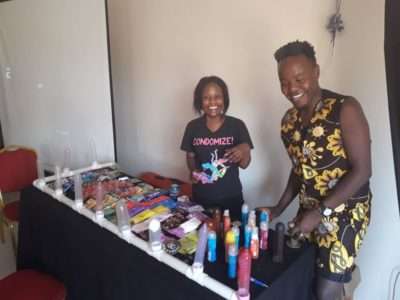
There are also several local organisations that have been working to serve the health needs of KPs. For instance, the Planned Parent Association of Zambia (PPAZ) has partnered with the Ministry of Health via NAC to provide KP-related HIV services in Livingstone.
Some CBOs have trained peer educators and lay counsellors that have been helping in mobilising LGBT+ members to access health services in Lusaka. One local CBO has also trained paralegals to meet legal service needs of the LGBT+ community across the country. Other towns have been slow to warm up to both mobilisation and health services provision targeting the community.
KP-related projects under some INGOs have seen more peer promoters and educators being trained. This has expanded the reach of HIV service provision in different target project implementation areas under Fhi360 for instance. Furthermore, Fhi360, an INGO, has helped train about 40 paralegals. This number adds to the already existing paralegals trained by local CBOs.
Amidst these impressive developments, the question remains of whether the LGBT+ communities and sex workers are ready to utilise the mainly free HIV services available to them. One local CBO worker, *Julie Mwanza said: “The community (LGBTQI+) is failing to take this rare opportunity to access and utilise the health services from friendly health centres and HCPs we have partnered with… It is as if what we are trying to do is going to waste.”
An employee from another local CBO, *Lydia Mukuka echoed the sentiment. “We are trying to pull the community towards our sensitised and trained HCP, but at times it is hesitant and seems not interested.” It appears the problem is not completely about access, but also the effective utilisation of HIV and other related health services. This is where the work of peer promoters and educators is becoming increasingly important. They provide a discreet and trusted link between the LGBT+ communities and the service points.
A check with one INGO employee, *Peter Chileshe, revealed that a lot of work is going on to strategically improve the utilisation of services among their implementing partners. However, one of these partners terminated the relationship as of November 2017 due to institutional requirements beyond its control.
“We have a large pool of peer promoters on the ground in all eight target districts,” Chileshe emphasised. “It’s not easy to convince the key populations that the services are safe and secure. What we need to do is to continue finding creative ways of reaching out to the unreached key population pockets that remain sceptical about the motive of our project goals and objectives.”
When interviewed, *Lambe Kapya and *Thandie Phiri, both peer promoters under Fhi360, who identify as gay and transgender respectively, revealed that it is not easy to reach out to the LGBT+ communities. One reason they cited was that most community members are sceptical and afraid. They agreed that they often have to accompany community members when visiting health service centres.
Since the National HIV/AIDS/STIs/TB Council (NAC) launched the first KP-inclusive National Strategic Framework (NASF), spanning the period 2017 – 2021, the unrelenting negative media publicity has not helped. This only serves to further stigmatise and drive the beneficiaries of the KPs health programmes and projects further underground and away from existing friendly and tailored health services.
The injection of INGOs and the Global Fund through the Ministry of Health has served as pioneering entry points for the health needs of KPs. The environment remains unpredictable and hostile. A lot of work needs to be done to ensure peer promoters reach the unreached through existing social and sexual networks of LGBT+ communities across the country. The work of peer promoters is important in achieving the UNAIDS Fast Track goals of reaching 90-90-90 target figures in Zambia.
* real name withheld

COMMENTS