

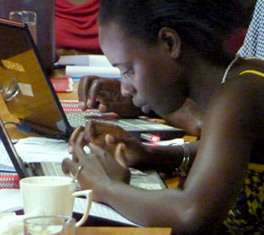
In a community dialogue held at Kawempe Muslim Primary School in Kampala, Uganda today (4 August 2011), participants from all walks of life including local leaders, community members and health workers and civil society representatives debated the crisis over maternal and child mortality in Uganda.
In an open debate based on realization that maternal death is a crisis in the country that accounts for 16 deaths everyday, the core of the argument was that these deaths could be prevented.
Amoding Dorcus, the Advocacy Officer for CHAIN (Community Health and Information Network) Uganda, said: “This coalition is meant to fight the situation women are going through. We aim at making women’s lives better. There are a number of organizations and we shared ideas and stood together on this. This does not only revolve around civil society organizations but Uganda as a whole.”
According to Amoding, the aim of the community dialogue is to bring people into the discussion to find out how best mothers in Uganda can be supported. He stressed the need for people to use the opportunity to cause change.
Maxiciencia Nakibuka a Community Health Worker, asserted: “When women die in this country no one bothers. Many women are dying yet it is them that produce us This campaign started long ago and I thank civil society for putting up this fight - but now we want it to be a community campaign so that people and government understand the importance of these things.”
“If women die who cares? It is just like when HIV/AIDS had started and people did not care. I say ladies and gentlemen today listen as women give evidence. Children are being infected at birth. Sixty children today are born premature between four and eight months at Mulago hospital and sixteen of these die each day. ”
In the dialogue Regina Namata Kamoga, the Country Director CHAIN-Uganda, said that to bring a child in this world is supposed to be joyful but it is sad here. She described how, if you are seen throwing a baby shower, people will say you are calling upon bad luck on the child because of the possibility of death.
Giving a personal testimony she said: “ I produced my second child in one of the big hospitals. I followed all the procedures religiously but few days to delivery I got a fever. I was taken for scanning and the health worker looked keenly but said nothing. She told me to go home. The next morning when I went to the bathroom I was bleeding a lot. I called my husband and we went to the hospital nearby. I had lost half of my blood by the time I was operated on.
“When my doctor came he told me I had a placenta previa, something I had never heard of. He said I was one of the few women who had survived from this. If my husband was one of those men who go to the bar when their wives are pregnant I would not be alive and if I had not taken medicine to increase my blood level during antenatal care I would have died.”
Sserwada Juma, the chairperson of the local council, pointed out that the space in which health services are offered is small. Juma noted that the attitude of some health workers was not good and that health staff should be trained in customer care if things were to change.
He argued that health workers no longer acknowledged their oath of saving lives. Citing an incident when his wife delivered, he said: “There were two rooms at the health centre, one had light and the other did not. The health workers said the women in labour in the room that had no light should wait until they were through with those in the room that had light so that they could see. They could have got the bulb, which was working outside and used it but they never. I went and bought a new bulb for the room.”
Country Director for International HIV/AIDS Alliance challenged local leaders when he enquired whether there was placement for health issues at the local level. It was pointed out that government needed to prioritize health issues even at local level. One of the female local leaders noted that there was a councilor in charge of sanitation and another on women issues, but there was no specific position that handled health issues. The County Director then proposed that there ought to be a secretary of health at local level.
The community dialogue voiced the need for the government to be at the forefront in implementing the good policies on maternal and neonatal health that it has made but not enforced.