

Efforts by the Ugandan government to ensure HIV positive schoolchildren from island communities can access treatment are being hindered by migration of their parents, who are fishermen.
Several years ago, the government introduced a free universal education system for all primary and secondary school children. There is also the free antiretroviral treatment for all those who are living with HIV, accessible at heath centres and hospitals countrywide.
However, fishermen on islands including Bugaala, Kachungwa and Bukasa in Kalangaala district, are like pastoralists – always on the move in search of fish. They take their school-aged children with them as they move, which results in their children abandoning their treatment.
Fishermen speak out
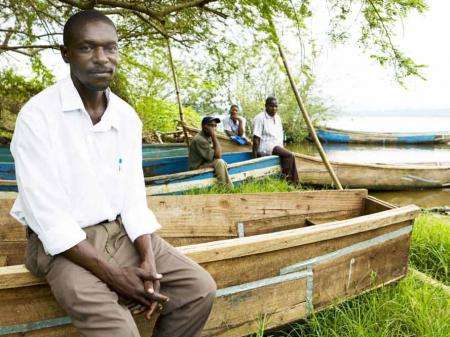
Simon (not his real name), a fisherman at Serinnya-Boosa landing site in the Kalangaala Islands, said fishermen can only sustain their livelihoods through moving from one landing site to another in search of fish.
“I am always in search of bigger earnings. Once I am informed of an increase in fish catch at a particular landing site, automatically I have to move with the family. My first priority is always the fish I will catch at the new site, not health services,” Simon said.
Nsubuga Bashir Kamadi, another fisherman at Serinnya-Boosa, said it is very hard for any fisherman to leave his family behind while relocating to a new landing site.
“If I am to relocate to Mazinga from Serinnya-Boosa, automatically I have to move with my family because the distance in between is 30 miles. If I leave my family behind, I have to raise 250,000 shillings (US $100) to visit them, which I cannot afford,” he said.
Kamadi also said that some of the landing sites where they relocate are in remote areas, where health services are very scarce.
Failure to stick to treatment
According to David Tusubira, the head teacher of Kibanda Primary School on Bugaala Island, 22 out of his 586 pupils are living with HIV.
“Fishermen with HIV positive children have failed to understand the importance of antiretroviral treatment,” Tusubira said. “Our hopes have always been that such children should complete their studies, and remain healthy, since they are on antiretroviral treatment. But such hopes are shattered by their parents and guardians who migrate in search for fish and, in the long run, neglect their treatment.”
He also said that the school had formed an Association of Parents and Guardians with HIV positive children, to educate them on how their children can stay alive and well, but such efforts have gone to waste.
Emmanuel Kasolya, district education officer of Kalangaala said that out of 4,700 school-aged children on the islands, 100 were HIV positive. He said that this figure might even be higher, but some children do not want to disclose their HIV status for fear of stigma, while others are always on the move with their parents.
School accommodation
Kasolya added: “Migration of fishermen with children, especially those who are HIV positive, is a big problem because some relocate to very remote islands, where accessibility to health services is very limited.
“However we have managed to partner with some NGOs like Action Aid, which has assisted us in constructing boarding sections at some schools, where HIV positive children can be accommodated, so they are not affected by the migration,” Kasolya said.
But Josephine Namutebi, head teacher of Beta Primary School, also on Bugaala Island, said although she has a boarding section to accommodate HIV positive children, some parents still forcefully take away their children.
“As a school we negotiated with some parents whose children are HIV positive to allow us to accommodate them in the boarding section. Even during holidays they remain with the teachers for easy accessibility to treatment,” Namutebi said. “However some parents are stubborn. For example one parent deceived the school, saying he was taking the child to visit some relatives, but when the term began the child was nowhere to be seen. The school was only recently informed that the parent left this son at his grandparents’ home. As they could not monitor his treatment, he died.”
Government response
The state minister for higher education, Dr John Chriszestom Muyingo, said parents who refuse or neglect to take their children for antiretroviral treatment should be brought before a court of law. He appealed to head teachers to liaise with local leaders and arrest such parents, because it is a child’s right to access treatment.
The permanent secretary in the Ministry of Health, Dr Asuman Lukwago, said although the Ministry has designed messages on how HIV can be addressed, most fishermen have not responded positively.
He added: “With assistance from the Global Fund, we are devising special ways of how the migration of fishermen with their school-aged children can be addressed.”
Read about HIV and human rights