



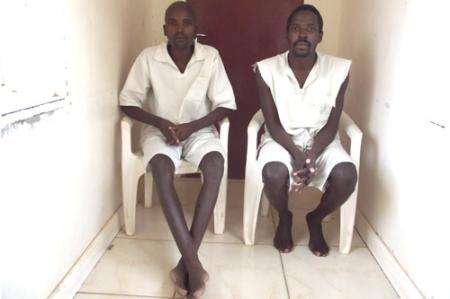
In Malawi’s prisons, many men engage in sexual activity with each other, including as a means of survival, yet the government is failing to protect their health and provide condoms.
Anderson*, a previous inmate at Chichiri, one of Malawi’s central prisons, said: “There was sex among men taking place inside the cells. Mostly it was the prisoners who had been in the jail for a long time and they act like leaders in the cells, and were forcing newcomers to have sex with them. However, sometimes others were doing it because they were sexually starved, while others were exchanging sex for things like a better space to sleep on, food and soap.”
Organisations such as Medecins Sans Frontieres visit inmates in the cells, bringing HIV and other sexual health messages to help prisoners live a healthier life both in prison and when they get out. However, crucially, government policy means condoms are not allowed to be distributed and inmates are being put at greater risk of HIV. “Sex; it’s done without protection and most newcomers are victims of it,” said Anderson.
The Malawian Ministry of Health’s director of HIV and AIDS, Dr Frank Chimbwandira, said: “As medical people we take vows to save people’s lives. Our primary responsibility is therefore to provide health services no matter how the person got infected. When a prisoner comes to the hospital with sexually transmitted infections, we assist everyone in spite of sexual orientation,” he said.
But the point is that nothing is being done to prevent infection in the first place. Same-sex sexual activity is currently illegal in Malawi, but accepting that it is going to happen, decriminalising it and designing and implementing an HIV policy for prisoners would be a good place to start. It certainly makes no sense for the government to restrict organisations willing to distribute condoms inside cells from doing so.
The homosexuality debate
Under Malawian law same-sex acts for men are punishable by up to 14 years in prison, and for women up to five years.
When Joyce Banda took over the presidency in 2012, she vowed to legalise homosexuality and later temporarily suspended the sentence that targeted same-sex relations. However, the law was never repealed and according to the current government’s spokesperson Jappie Mhango: “President Peter wa Mutharika has made it clear that the issue of homosexuality will be addressed through referendum.”
Mhango however could not say when the referendum is likely to take place. But if the previous leaders’ ‘delay tactics’ are anything to go by, there is little hope that the referendum will be held soon or that the law will be repealed.
Yet activists trying to get the law repealed point out that the penal code sections banning homosexuality are in conflict with the constitution. And in event of inconsistency, the Constitution invalidates the law.
The Malawi Constitution does not specifically prohibit discrimination on the grounds of sexual orientation. But, according to Section 20 of the Malawi constitution: “Discrimination of persons in any form is prohibited and all persons are, under any law, guaranteed equal and effective protection against discrimination on grounds of race, colour, sex, language, religion, political or other opinion, nationality, ethnic or social origin, disability, property, birth or other status.”
An incomplete response to HIV
Data has started to emerge in Malawi which, if used to inform programming, would improve the HIV response to male prisoners. But although prison authorities have acknowledged that homosexuality takes place in their prisons, progress in providing access to sexual health services is slow.
Gift Trapence, executive director of the Centre for Development of People, an organisation working on sexual health and the human rights’ of minority groups, said: “A study done in 2011 shows that the HIV prevalence is significantly high in central prisons. […] The question now is not lack of data but rather commitment to address the structural barriers and factors contributing to HIV and STIs infections in prison.
“The sodomy laws make it difficult for service providers to offer comprehensive programmes to address HIV and access to treatment in prisons. For example HIV policies have recognised the need to make condoms available in the prisons but this has not happened because of existing laws.”
The government’s stance towards homosexuality and its lack of policies for men who have sex with men have huge implications for the response to HIV. But there is a glimmer of hope.
The government has recently accepted a grant from the Global Fund to Fight AIDS, Tuberculosis and Malaria which includes working with men who have sex with men in the response against HIV. It is a small step.
But when the government stops prohibiting prisoners from accessing condoms, and takes a proactive stance on men who have sex with men, the battle to tackle the pandemic will take a clearer direction.
*Anderson’s name has been changed to protect his identity.