Supporting adolescents’ health and rights is an important key to ending HIV, unsafe abortions, early child marriages, unwanted pregnancies and sexual gender-based violence.
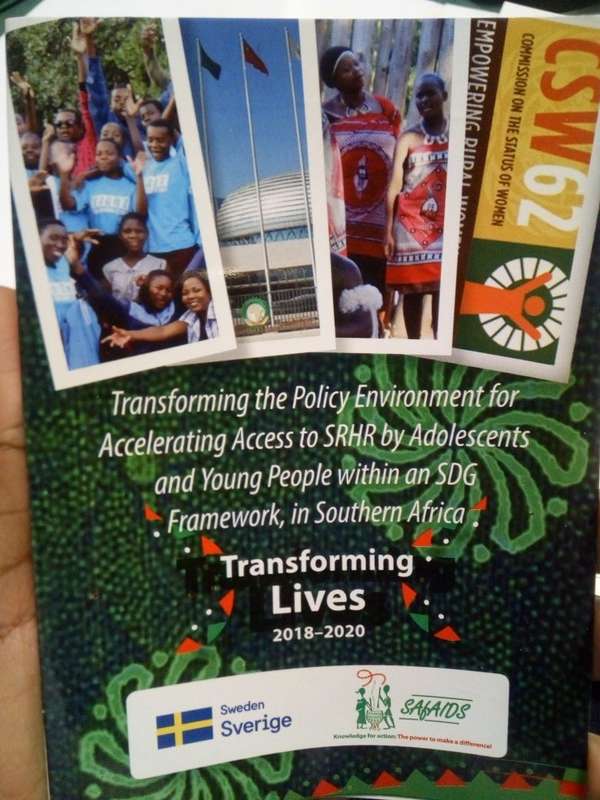
On the 12th of April 2018, the Southern Africa HIV and AIDS Information Dissemination Service (SAfAIDS) hosted a workshop in Lesotho. Its focus was on a Sexual and Reproductive Health and Rights (SRHR) advocacy programme. SAfAIDS is implementing a three-year regional policy and advocacy programme across the Southern African Development Community (SADC) region. This will run from 2018-2020 and it’s titled: “Transforming Live; Transforming the policy Environment for Acceleration Access to Sexual Reproductive Health and Rights by Young People within an SDG programme.”
The programme’s focus is on the prevention of sexual gender-based violence (SGBV), teenage pregnancy, unsafe abortions, and the promotion of social accountability monitoring for access to SRHR services by young people in Southern Africa. According to SAfAIDS the programme was introduced because many girls are coerced into unwanted sex or marriage. Compromising their SRHR in the process. This often puts them at risk of consequences associated with early sexual activity including HIV/AIDS.
Many relevant stakeholders were invited to the workshop. Included were members of Parliament, Champions, Key Correspondents (citizen journalists), Non-Governmental Organisations, Inter-Governmental Organisations, Ministry of Gender, Ministry of Health, Ministry of Education and Ministry of Justice. The members admitted that in Lesotho advocating for adolescents’ SRHR can be challenging despite the critical health issues at stake. Most participants indicated that religion and culture serve as serious barriers in addressing these rights.
One of the students who was invited *Mpho T’solo from the Lesotho College of Education said, “Having a father as a pastor makes it difficult for us to talk about SRHR at home or even at church. Although I have some information. It is unacceptable and is considered disrespectful.”
It was stated by most participants that adolescents lack the comprehensive information necessary to allow them to make informed decisions about their own SRHR. This, because society’s norms consider it as taboo to talk about these issues. Even those who can find accurate information may be unable to access the services they need to protect their health.
As a Champion and a Key Correspondent I was among the key note speakers. My focus was on whether the national laws and policies in Lesotho protect or impede the rights of adolescents to access SRHR.
I stated that: Although Lesotho has laws and policies that are comprehensive on SRHS such as the Sexual Offences Act 2003, Penal Code 2010, Lesotho Constitution 1993, Children’s Protection and Welfare Act, 2011, Penal Code 2010 and other policies, there is still much to do. This is because we have good laws on paper but the application of these law is a serious problem for various reasons. There are gaps. Firstly, most people do not know about these laws. Secondly, those who know about the law are sometimes impeded by their religion and culture. As there is sometimes conflict between these practices and the law.
In addition, Lesotho’s laws are sometimes contradictory and their application can be very difficult in court. An example is the Lesotho Marriage 1974 versus the Children’s Protection and Welfare Act, 2011. Under the Marriage Act a girl can marry at the age of 16 while the Children’s Protection Act defines a child as a person below the age of 18. So where the former disempowers the latter empowers.
As the Marriage Act stands young girls below the age of 18 can by law get married. But as a result their sexual reproductive rights are compromised as they are in fact still children. These girls are not necessarily mature enough to make informed decision about their bodies nor do they necessarily have the capacity or depth of understanding of the long-term repercussions of their actions. Even under custom a girl can get married at the age of 16.
There was also a mention of the criminalisation of Prostitution and Abortion under the Penal Code. Regarding Prostitution, more emphasis was put on young sex workers as a disadvantaged group. They are part of the minority groups in need of protection of their human rights. Sex workers’ enjoyment of their right to health and access to justice is heavily compromised due to criminalisation of sex work by health care workers, police and members of the public.
Another issue which was raised as a serious concern was the Criminalisation of Abortion in Lesotho. Criminalisation corners girls into have children at a young age. It denies them the right to what happens to their own bodies – whether to keep their child or not. This in turn results in most young girls resorting to unsafe abortions which have serious and often life-long health implications. Women and girls face high levels of injury and death because of unsafe abortions. Mothepane Thahane a public relations officer at Queen Mamohato Memorial Hospital says illegal abortions have reached a crisis level of about 60 percent. She Thahane was quoted in the Sunday Express of May 22, 2018.
Based on these deliberations it was agreed that there is a need to advocate for the SRHR of adolescents. This means empowering young people to know and exercise their rights. This includes the right to delay marriage and the right to refuse unwanted sexual advances. This would also allow adolescents to have access to services relating to their health.
Karabo Mokobocho-Mohlakoana is based at the Lesotho college of Education. She emphasised the importance of adolescents being taught about SRHR, “We have introduced a course addressing SRHR because we realised that most students fall pregnant and some would even drop out of school because pregnancy.” She added that: “Some of these students are impregnated by older men who advise them to resort to illegal abortions.”
The participants suggested that the starting point should be at the community level where chiefs, traditional and religious leaders can take the lead by assisting activists to raise awareness. Since in Lesotho people are deeply rooted in their culture and religion, the strategy to be engaged is to have them become enablers to advocate for human rights. There is a shared sentiment that shifting the mindsets of people will make it easier to change the laws.
“We should stop hiding behind culture and religion and face the reality. Our kids are dying while we are watching because of lack of information. I plead with everyone present especially people of high influence such as traditional and religious leaders to take a stance to rescue our future generation,” said Chief Khoabane Theko.
Members of parliament who were present made an undertaking to lobby their peers to change the laws affecting the SRHR of adolescents. Some have already started pushing the mandate forward. A week after the workshop, I was called to speak to the Lesotho SADC Parliamentary Forum on how early child marriages affects the SRHS of adolescents. It’s encouraging to know that this important conversation is continuing.
COMMENTS