
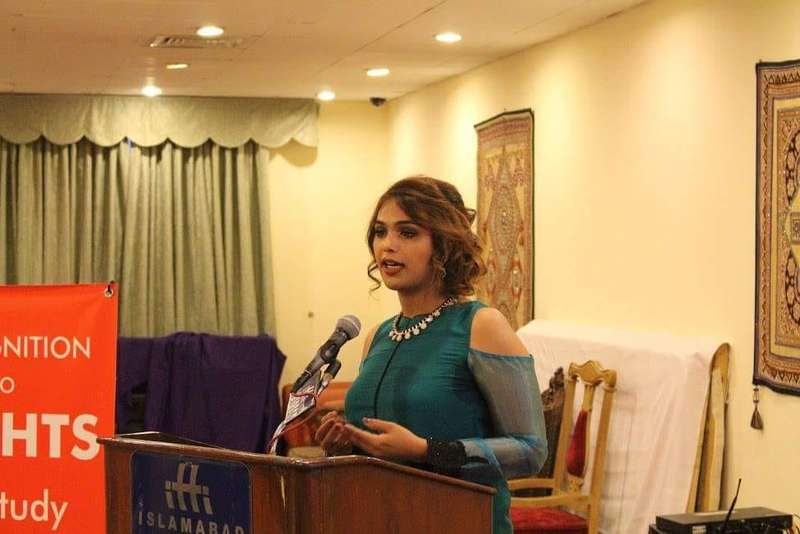
Pakistan joins the ranks of a growing number of countries protecting the rights of transgender people. Thirteen transgender people from all over the country are contesting for the chance to have a representative run at the general elections.
The transgender community around the globe faces high levels of discrimination, stigma and violence. Transgender people are sometimes killed in cold blood by their fellow human beings, reported Maya Zaman in her opening speech. She was addressing the issues of decriminalisation of Key Populations at the International Aids Society Conference (AIDS 2018) held in Amsterdam, the Netherlands from the 23rd – 27th of July this year, 2018.
Zaman is a young transgender activist representing her community members from Pakistan. She works for one of the leading organisations on gender and minority rights there called Forum for Dignity Initiatives (FDI).

Trangender activist, Maya Zaman
Zaman - like many other transgender people - faced all kinds of stigma and discrimination from society and her family. She was also abandoned by her family. Despite all this she did not give up. She continued to fight for her rights and the rights of other transgender people. Although there are still challenges that her community faces in Pakistan, she indicates the country has taken a historic step in addressing this heart-breaking tragedy. “The transgender community has made tremendous strides in fighting for their rights. This is because the movement is very powerful and [very] consistent in fighting.”
An important step was taken in Pakistan early this year. The landmark law, Transgender Persons (Protection of Rights) Act, was passed. The law guarantees transgender rights in Pakistan under the act.
Zaman mentioned that this law is one of the most progressive in the world. The law is comprehensive in protecting transgender rights across several aspects of life, including employment, education, health care, housing, voting amongst other rights. It bans discrimination and the violation of transgender rights. “While we applaud our government for this bold step, there is still [the] need to make sure that the law [is enforced], which is a serious challenge.” Some people in Pakistan are strongly opposed to the passing of this law, regarding it as immoral.
In July, some months back, thirteen transgender people contested the general elections in Pakistan for the first in the country’s history. Even though this is still deemed illegal, the efforts of the trans movement and its allies has convinced the government that transgender people are human beings too. After it was officially declared by the authorities that they are allowed to compete, they started serious campaigns to support interested candidates. Candidates were also empowered through training sessions and workshops that covered many topics relating to electioneering, campaigning, and leadership - to prepare them for a possible win.
“The biggest source of our happiness is that they are going to be the voice of the transgender community and minority groups in Pakistan. They will make sure that our voices are heard at the decision making process,” Zaman said.
She also believes that even if they do not succeed, the move to run for elections affirms that transgender persons are here and need to be a part of the country’ decision-making processes. It raises an alarm to the entire community. It also worth noting that Pakistan opened its first school for the transgender community in April, 2018.
“Despite this progress, the battle is half won because we are still faced with other realities. Transgender women cannot get married because a sodomy law still exists in my country”. The sodomy laws prohibits and criminalises “carnal intercourse against the order nature”. The fight is ongoing. The community is now advocating for the decriminalisation of the sodomy law. This a colonial, British Law, which is still in place in many former British Colonies. Referring to her past experiences, she is still hopeful that even this battle will be over soon.
In advising other transgender people who are still facing serious challenges in their respective countries and families, Zaman indicated that it has never been an easy journey. They were experiencing transphobia in various ways at any given time but they never give up. “You need to be persistent in what you want but be respectful at all times,” she said.
However she did mention that it also takes time and that transgender communities facing similar struggles across the world must be patient. She also encouraged these communities to build a strong trans movement, and allies to support the struggle. “Rome was not build in one day,” Zaman reminds us.
She also sends a warning to some hostile government departments saying that times have changed and the law has to change with the evolving society. They should learn from Pakistan and other progressive countries if they really want to end AIDS by 2030. Breaking Barriers - Building Bridges means addressing all the root causes of HIV prevalence.

COMMENTS