
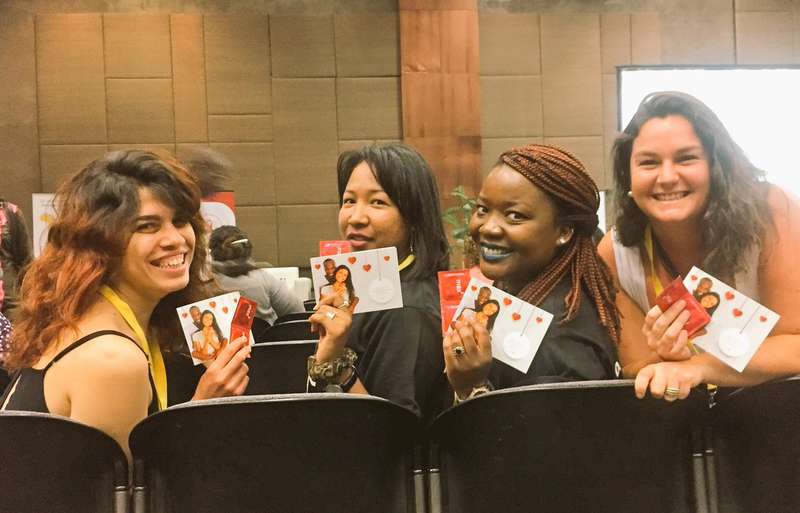
Young Feminist Championing Sexual Reproductive Health Rights for girls and women in Malawi.
In Malawi, it is difficult for women to explore their sexuality and own Sexual Reproductive Health Rights (SRHR). Cultural beliefs are used to police their morals based on their sexual behaviour. This makes the topic of sex a taboo and many women suffer due to lack of information and access to SRHR.
Young, Malawian feminist, Umba Zalira has flipped the script by using theatre as a way of having more women actively involved in SRHR advocacy.
She opens up on how her work has made an impact in an interview with one of our Key Correspondents.
Daphne Jena: What challenges do you try address for women regarding SRHR issues in Malawi?
Umba Zalira: Theatre for a Change in Malawi has been working with women and girls from vulnerable and marginalised groups since 2007. Our beneficiaries are diverse. We are working with women in sex work, sexually exploited girls, in and out of school girls and pre-service teachers in Training Colleges across the country. With all our beneficiaries we are developing their knowledge, attitudes and skills so they can make informed decisions which they are able to act on.
DJ: What are the two most dominant factors hindering women from their SRHR?
UZ: Women are a diverse group hence factors hindering them to access full SRHR are diverse as well. I can only speak for the girls and women we work with at Theatre for a Change. The hindrances are twofold: Firstly, it is at a personal level which is influenced by socialisation, culture and societal expectations. Women, sex and pleasure just don’t go in the same sentence in our cultures. This automatically changes the power dimensions in relationships which then determine who is making all the SRH decisions. This plays out differently for the beneficiaries we work with. Secondly at service provider level we are lacking tailor-made services that cater to all targeted groups. I know we have Youth Friendly Health Services (YFHS) but again boys and girls are considered as one group when their SRH needs and challenges are different and diverse. Breaking it down further we can look within the youth group: Are our YFHS friendly enough for young people involved in sex work? So the point is having tailor-made SRH services that are responding to the issues on the ground and speaking to people’s real life stories and challenges. 
DJ: What motivated you to work in SRHR advocacy for women?
UZ: I am a woman. I have SRH Rights. So my advocacy stems from my very personal lived experiences as a young woman in Malawi while realising that the realities for other girls and young women like me is much worse. So first acknowledging the privilege I have and sharing my story. But also creating spaces and amplifying the voices of others who cannot make it to the table I have access to.
DJ: With over 5 years’ experience working in SRHR, what is the impact of Malawi’s laws on sex workers and their access to SRHR?
UZ: The major impact is how the law continues to criminalise sex work therefore making our women more vulnerable and marginalised. Lack of harmonisation of laws and policies makes our work difficult. On one hand you have the law criminalising sex work while on the other you have the national HIV policy talking of Key Populations and addressing their SRH needs. This creates confusion and gives leeway for structural and systematic abuse and discrimination of women in sex work.
DJ: Being a young woman in a society that is opposed to homosexuality and sex work, what have been the challenges of advocating for SRHR rights for women?
UZ: Backlash from the communities, having to deal with centuries of a patriarchal structure that systematically oppresses and abuses the body of a woman, and having to negotiate basic human rights.
DJ: As someone who uses theatre how are you addressing issues affecting female sex workers in Malawi? 
UZ: We are supporting the women to access platforms at community and national level where they can tell their stories in their own way. They are trained in collecting information, devising a story, and performing it for stakeholders at both levels. So we are using theatre as a tool of empowerment for the women, to amplify and advance their voices in key decision-making spaces at these levels.
DJ: How effective have been these methods?
UZ: Our unique and highly participatory methodology engages our beneficiaries in three ways; first we look at practitioners’ level of knowledge on the topic, then we explore their personal attitudes, and finally we encourage them to practice skills which they can easily use and adapt in their daily lives.
DJ: How different is theatre from other forms of advocacy?
UZ: The type of theatre we practice is called “interactive theatre”. It’s highly participatory and was invented by Augusto Boal. This type of theatre allows the audience at a certain point to not only change the story line but have a chance to participate in the drama. In addition our plots are inspired by real life stories that our women go through. Making them authentic and relatable for our audiences.
DJ: What’s your one recommendation for organisations advocating for sex workers?
UZ: To put the women at the very core of their organisation and implementation, having them not just as participants or beneficiaries but part and parcel of the whole process. At Theatre for a Change what we have done is train the women so that they lead in implementation of project activities, for example the women are trained to facilitate workshops and the behaviour change process with their peers. This method has helped women build their own capacities but also act as role models for their peers.
DJ: What achievements have you made on a personal, organisational, national and international level since you started working in SRHR advocacy?
UZ: There are a lot but I have more pride in the changes I have made at a community level more than anything else because change and revolutions begin at that level. I am most proud of a community organisation I co-founded with my two friends called Growing Ambitions. Our aim is simple: To provide a safe space for girls and young women to thrive through comprehensive mentorship and guidance.
COMMENTS