
Three transgender women speak on how the stigma and discrimination they face has escalated, and why they suffer more than other members of the LGBT+ community.
Although public attitudes have been slowly changing on issues around LGBT+ persons in Lesotho, the same can’t be said for transgender persons. Identifying as lesbian, gay or bisexual poses a threat to the individuals who do so. And transwomen face even more prejudice – more than transgender men for instance. GLAAD is a non-governmental media monitoring organisation. Formerly the Gay & Lesbian Alliance Against Defamation, in becoming more inclusive of bisexual and transgender issues it then focused on adopting the acronym as the official name. The NGO found that the victims of transgender violence are “overwhelmingly transgender women of colour”, who are marginalised economically and socially and who “live at the dangerous intersection of transphobia, racism, and sexism”. Transwomen live under constant threat of horrifying violence and abuse. And often what brings these trans communities together are the sad stories and experiences of what they’ve been through because of who they are.
Discrimination manifests in different ways and is at times levelled by the same community transgender people are presumed to belong to – the LGBT+ community. Many trans people often speak to feeling unwanted and out of place. Many still are accused of being attentions seekers. This is the result of the negative ways in which society views trans people. The Huffington Post argues that by being included in the LGBT+ acronym, trans people are considered to be an obscure and misunderstood subcategory within the broader, and more understood, gay community, and that trans people need to be recognised as their own group.
Bathu Leoma*, a transwoman from Masuoe, Maseru, has always been and felt feminine. She admits that hers is not an easy life. She says: People hate you just because they think you are looking for attention. However, she also acknowledges that her family and friends have been extremely supportive throughout her journey. She is particularly grateful for her father who has always known of her identity and accepted her.
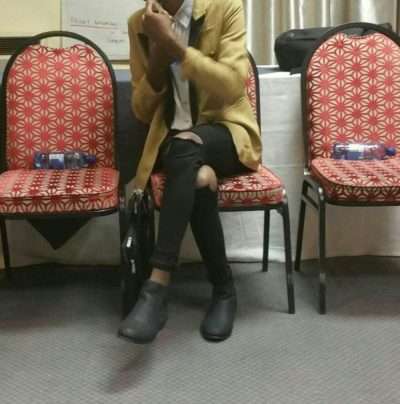
photographed here is Batho Leoma*
“He was always protecting me in childhood. He accepted me as his daughter,” she says. “When you’re a transwoman, you ready yourself for war every day.” Just walking on the street poses a threat to transwomen who are often harassed and called names. “Sometimes it leads to violence”, she explains. Many men want to engage with them sexually, as a fantasy, although they do not want to be seen in public.
Keke*, a transwoman from Mafeteng, says she was constantly bullied at school. She felt that she could not share her experience with anyone. She came out to her mother when she was 21. Convinced that she has been influenced by an evil spirit her mother sought the help of a pastor - to pray for her. Keke accepted that pretending to her mother that she was happy living as a boy was the only solution. She since moved away from home and now lives comfortably as a woman. Still, her new community is not kind.
“I wish I was never born a transwoman.”
“If this was a choice I would have quit a long time ago,” her voice trembles. Keke is not ready to disclose her identity to the rest of her family. Her past experience has created a profound fear of rejection. “People who know about my identity are some members of the LGBT+ community,” she says.
Keke says she has not been lucky in love: “You meet a guy and the next thing you find yourself in trouble when you disclose or he discovers your identity. The guy feels tricked upon learning that you are trans and trouble starts. This leads to violence at times. Few men who date you knowing that you are trans would want to be seen with you. You often meet in awkward places,” says Keke. She adds that dating is difficult because even transmen don’t want to date.
Even at healthcare centres, people like Keke face roadblocks in accessing health services. She recalls one particularly traumatic visit to the hospital where she was ordered to take her clothes off. When a nurse discovered that she had male genitalia she asked, “So you are a boy who decided to disguise himself as a girl?”
“People think we just decide one morning when we wake up that we want to be girls or women and it’s hurtful,” she says.
“We have to worry about what bathrooms to use,” Mpho Nkobane, a transgender women from Matelile, describes.
“We are harassed when using public toilets and it’s an everyday reality for transwomen. If I got to either toilet, I know that I should be prepared for a bomb. There will be shouting and shaming. At times people will even call the security guard to embarrass me,” she said.
At one mall Mpho Nkobane was forcefully removed from the bathrooms. She was not allowed to use the women’s or the men’s toilets. Nkobane says she was depressed and cried for hours, not telling her parents about the incident because they would say that she had brought it upon herself.
Although transgender women make up a small percentage of the LBGT+ community – data from University of California, Los Angeles found that in 2007, less than 0.5% of adults between 18 and 64 years old identify as transgendered women, although this number is arguably larger today – The researchers remain hopeful that one day people will hear their voices and embrace gender diversity. These three women are an example of the many who are proud of who they are and won’t stop their fight for equal rights. Even though change requires effort and patience.
They think it’s important for other transwomen to know that they are not alone. And that they should: “Take courage and don’t let anyone stop you from being who you are.”
*The source’s real name was not used to protect their identity.
COMMENTS